
Here’s to the second Roulette post! Let’s go about randomly picking the company financials to write about today.
The random letter is “G” and the random number is 10. After some meticulous counting, I’ve discovered that Glencore is the company we’re focusing on.
A more prominent company this time, my friends. Remember, our first post was on a data company called YouGov? Maybe there’s more to sift through today.
I was wondering why I remember Glencore. It turns out, for some reason, I can recall their Congo mine incident in 2019. The things our brains remember… I think it’s kind of random.
1-Minute Company Overview
Glencore plc, based in Switzerland, is focused on the production, refinement, processing, storage, transport, and marketing of natural resources. There are three sections of the company: metals and minerals, energy products, and agricultural products.
Some metals and minerals Glencore deals with include copper, zinc, cobalt, and coal.
Commodities Price Fluctuations
One of the things I like about reading financial reports is that we can see how the macroeconomic events of the past year affected certain sectors. With Glencore, we’ll get a good look at the commodities market.
Let’s dive right in. For the rest of this post, I’ll mark down things I find interesting from Glencore’s 2023 Half-Year Report. You can find it on Glencore’s Publications page here.
2023 coal and gas prices are more normalized compared to the volatile prices of 2022. 2022 was characterized by macroeconomic instability and supply disruptions that caused prices to rise. Because of this macro change, for this period, income attributable to equity holders (net income minus preferred dividends) fell 62.2% and EPS fell 60.8%. 50% and 59% drops in adjusted EBITDA and EBIT respectively were attributed to rises in inflation, monetary policies, and limited Chinese economic growth.
Financial Statements
The income statement reflects what we talked about in the previous paragraph. I’d say the balance sheet values for half-year 2023 are not largely different from half-year 2022.
Revenue is dominated by the marketing activities segment – there are only two, the other being industrial activities.
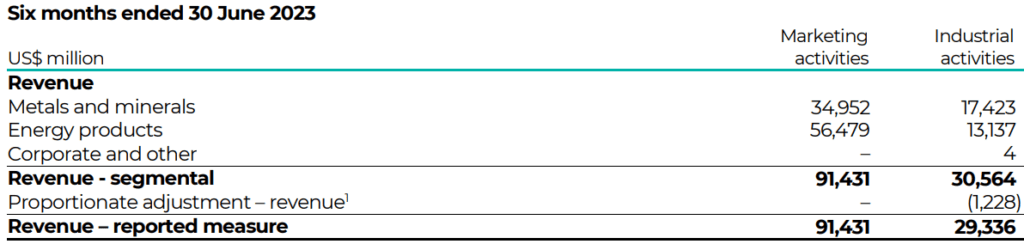
Honestly, there doesn’t seem to be much to see in the document. The key takeaway appears to be how hard hit the company was by macroeconomic events and supply disruptions over the pandemic period. And now, the main issue is inflation.
Naturally, all companies are affected by these factors to some degree. But given the nature of Glencore’s business (commodities), the effects are overwhelmingly pronounced.