
Recently, the UK Supreme Court established that artificial intelligence can’t be named as the inventor in a patent application. Under existing law, an inventor must be a “natural person”, which an AI isn’t.
TLDR on the case: Dr Stephen Thaler named his AI, DABUS, as the inventor of two things, one related to food packaging and the other a type of flashing light. He sought to establish his rights to the patent due to his ownership of the AI.
This ruling isn’t exactly new. Thaler had already attempted to register his DABUS patents in other countries. The US rejected Thaler’s application back in April.
There are many interesting comments on this case, from professionals to insightful individuals. I wanted to compile a few here.
Further Implications Not Considered
It should be noted that this ruling doesn’t consider many other factors. Basically, what we’ve learned is that AI does not equal a “natural person”, and the inventor of a patent application must be a natural person.
If it had been Dr Thaler’s case that he was the inventor and had used DABUS as a highly sophisticated tool, the outcome of the proceedings may have been different. However, the Supreme Court was not asked to decide this question. Neither was it asked to determine broader questions such as whether technical advances generated by AI acting autonomously should be patentable.
Tim Harris, patent litigator at law firm Osborne Clarke
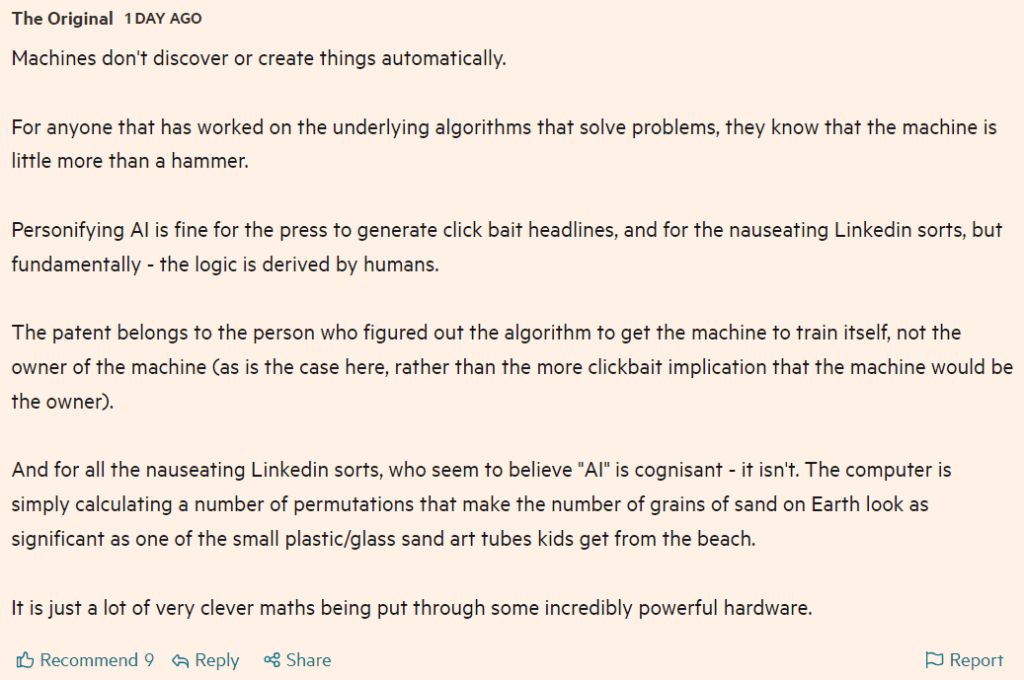
AI is Merely Code?
I’m assuming this comment comes from someone who knows about the behind-the-scenes processes of artificial intelligence. As someone with a surface-level understanding of it all, I do appreciate the input. The comments under this comment concur.
Parallels to AI Art
In mainstream media, we hear much more about the impact of AI art. Who is the creator of the piece of art an AI generated?
There are similar debates in other areas of intellectual property rights too. Copyright in AI-generated works, for example. Is the programmer of the AI the creator, or the user who is responsible for prompting the machine? And what if it really is just the machine itself, like Dr Thaler claimed of DABUS?
Simon Barker, intellectual property litigator at law firm Freeths
Check out our previous law post about the legal regulations in the US, UK, and Japan related to the police lying during interrogations.